
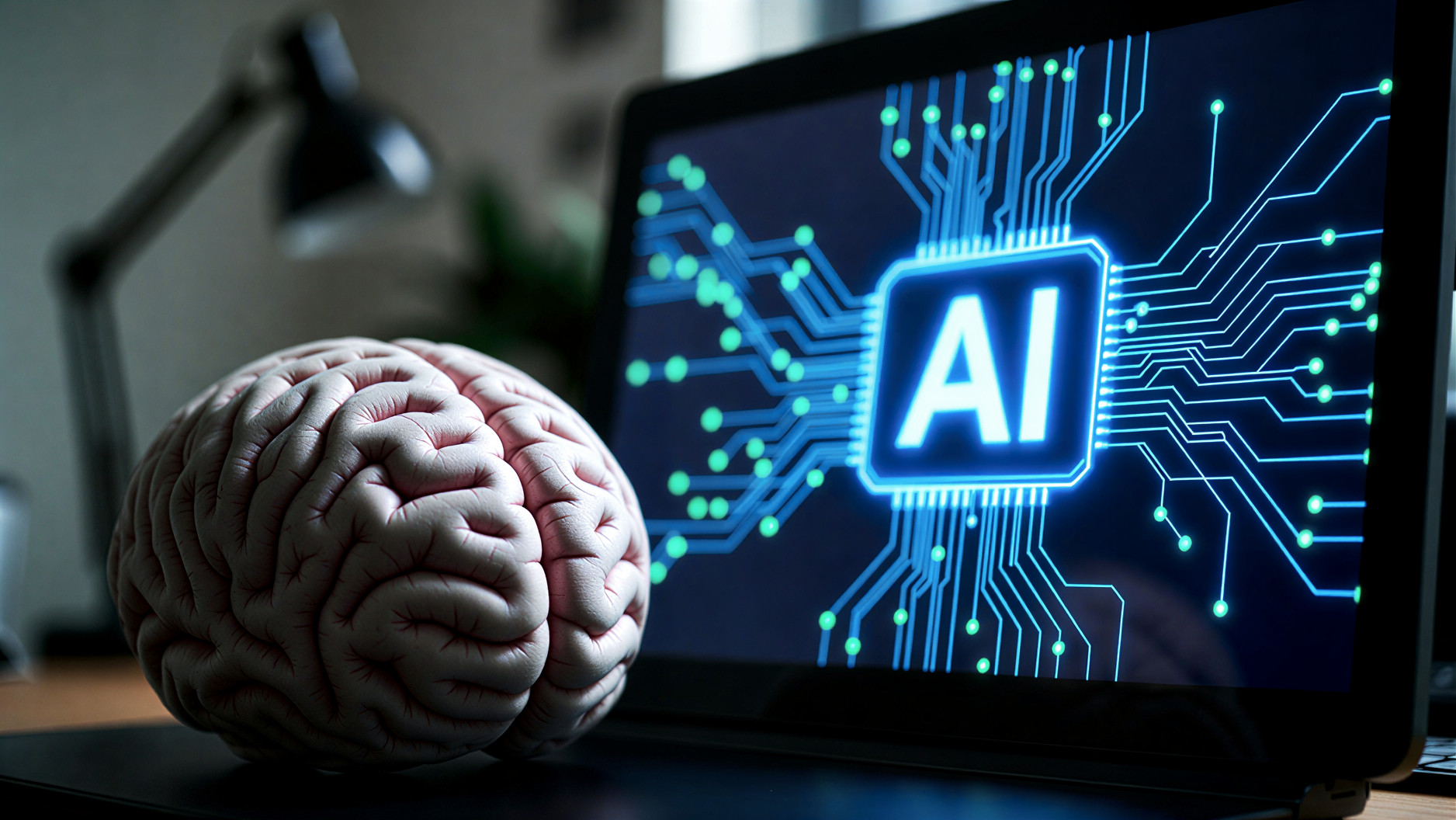
If you’ve been online lately, you’ve likely seen the heated debate: Silicon Valley’s golden boy, Sam Altman, essentially told the internet that our brains are energy hogs compared to AI.
The backlash was instant. Critics pointed out that while a data center requires a dedicated power plant, your brain runs on a single slice of avocado toast and a cup of coffee. But as we head deeper into 2026, the data suggests the answer isn’t as simple as Team Human or Team Robot.
The 20-Watt Wonder vs. The Gigawatt Giant
Let’s look at the hardware specs. The human brain is a masterpiece of biological engineering. It performs trillions of operations per second while consuming about 20 watts of power. To put that in perspective, that’s less energy than the lightbulb in your refrigerator.
On the flip side, training a frontier AI model like GPT-5 (or its 2026 equivalents) consumes millions of kilowatt-hours. In fact, OpenAI CEO Sam Altman recently sparked a firestorm at the India AI Impact Summit (February 2024) by reframing this comparison.
“It takes 20 years of life and all the food you eat during that time before a human gets smart,” Altman argued.
His logic? We often forget the training cost of a human-two decades of schools, meals, and infrastructure-before comparing it to an AI that is already trained and ready to work.
Efficiency
To understand who wins, we have to split the “efficiency” trophy into two categories:
- Inference (Using Knowledge): This is where AI is catching up. Once an AI is trained, asking it a question takes a fraction of a watt-hour. Altman claims that on a per-task basis, AI is now more energy-efficient than a human performing the same calculation or coding task.
- Learning (Acquiring Knowledge): Humans still win by a landslide. You can see a cat once and know what it is forever. An AI needs to see 100,000 photos of cats before it stops confusing them with blueberry muffins.
| Feature | Human Brain | AI (2026 Models) |
| Power Consumption | ~20 Watts | Megawatts (Training) |
| Data Needed to Learn | Very Low (Intuition) | Massive (Big Data) |
| Task Speed | Slow/Deliberate | Near Instant |
| Multitasking | Excellent (Parallel) | Narrow/Resource Intensive |
The Black Swan Problem
The biggest logic gap in the AI is better argument is what experts call Neuroplasticity. Our brains physically rewire themselves in real-time based on a single experience.
If a 2026 AI encounters a “Black Swan” event-something it hasn’t seen in its training data-it often hallucinates or fails. A human, however, uses intuition and messy logic to improvise. As Meta’s Chief AI Scientist Yann LeCun recently noted, AI is still limited to language, while the human brain processes a high-dimensional, noisy, and continuous real world.
Why This Matters for 2026
Google Discover and the rest of the web are currently flooded with AI-generated content. However, users are gravitating back toward Human-In-The-Loop systems. Why? Because while AI is efficient at processing data, humans are efficient at understanding it.
Sam Altman’s goal is to reach AGI (Artificial General Intelligence) by 2028, predicting that data centers will soon hold more intellectual capacity than all of humanity combined. But until an AI can run on a bowl of oatmeal and solve a brand-new problem without a system reboot, the human brain remains the undisputed heavyweight champion of efficiency.
AI is a Silicon Titan for raw speed and data crunching. But for creativity, empathy, and low-energy survival, your wetware is still the most advanced tech on the planet.
2 thoughts on “Is AI Really More Efficient Than the Human Brain?”